

Revision Rhinoplasty in Mumbai: When a Previous Nose Job Needs Correction
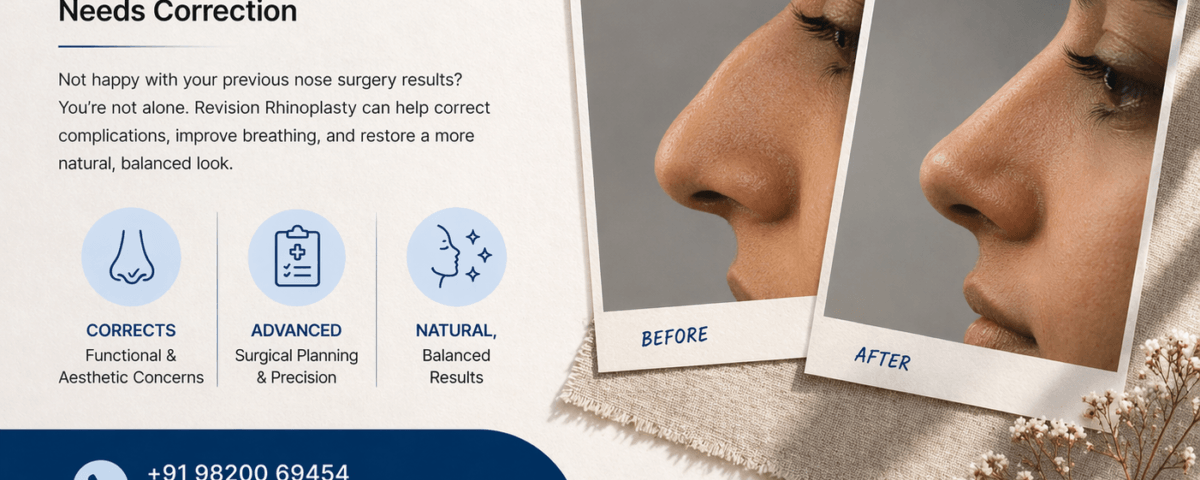
Not every rhinoplasty journey ends with the result a patient hoped for. If breathing feels worse, the nose looks overdone, crooked, asymmetrical, collapsed, or simply doesn’t match your face, revision rhinoplasty may be worth considering. This guide explains when a second nose surgery is needed, what can be corrected, and what patients in Mumbai should know before planning revision rhinoplasty.
Who usually reads this blog?
- Patients unhappy with an earlier nose surgery result
- People facing breathing issues after rhinoplasty
- Those noticing asymmetry, collapse, pinching, or over-reduction
- Anyone comparing first-time rhinoplasty vs revision rhinoplasty in Mumbai
Why Revision Rhinoplasty Matters
Revision rhinoplasty is a secondary or sometimes tertiary nose surgery performed to improve the appearance, structure, or function of a nose that has already undergone surgery. It is usually more complex than a primary rhinoplasty because the anatomy may have changed, cartilage support may be reduced, scar tissue may be present, and both the patient’s expectations and the surgical plan need careful review.
In many cases, the concern is not only cosmetic. Some patients come in because they feel the nose is too narrow, the tip looks pinched, the bridge is irregular, or the nose no longer looks natural from all angles. Others seek help because they experience nasal blockage, collapse while breathing in, or persistent dissatisfaction after their first surgery.
Aesthetic correction
Addresses issues like asymmetry, over-reduction, irregular bridge contour, droopy or pinched tip, and unnatural shape.
Functional improvement
May help when prior surgery has affected airflow, internal support, or the position of structural elements inside the nose.
Complex planning
Often requires detailed assessment of skin quality, scar tissue, remaining cartilage, and the need for graft support.
When Is Revision Rhinoplasty Needed?
Not every imperfect result requires another surgery. Some swelling can take months to settle, and subtle asymmetry may improve as healing progresses. However, revision rhinoplasty may be considered when the nose has healed and there are persistent concerns such as:
- Noticeable asymmetry that did not improve after recovery
- A bridge that appears too high, too low, too wide, or irregular
- A tip that is droopy, overly rotated, boxy, pinched, or unsupported
- Nasal collapse while breathing, especially on deep inspiration
- Breathing difficulty that began or worsened after the first surgery
- An over-operated look where the nose appears too small or unnatural for the face
- Visible notching, indentations, sharp edges, or contour defects
- Dissatisfaction because the final result does not match the pre-operative discussion
Why Do Some Primary Rhinoplasty Results Need Correction?
There is usually not one single reason. A revision may become necessary because of healing characteristics, scar contraction, skin thickness, prior trauma, structural weakness, aggressive cartilage removal, or limitations in how the first surgery was planned and executed. In some cases, the nose may look acceptable from the front but not in profile. In others, the nose may look fine at rest but function poorly during breathing.
Thick skin, weak cartilage, healing unpredictability, and pre-existing deviation can all influence the final result. A careful revision consultation should focus on what exactly went wrong, what the tissue condition is now, and what outcome is realistic.
Common Problems Seen in Revision Rhinoplasty
1. Residual Crookedness
Some patients still notice deviation after surgery, especially if the nose was significantly crooked to begin with or if the internal septum also contributed to the deviation.
2. Pollybeak or Tip Imbalance
In some noses, the supratip area remains too full or the tip lacks enough projection or support, creating an unbalanced shape.
3. Pinched Nasal Tip
This may happen when too much cartilage is removed or the tip support becomes weak, leading to a narrow or collapsed appearance.
4. Over-Reduced Bridge
If the bridge is lowered too much, the nose may lose its natural contour and appear scooped or structurally weak.
5. Breathing Difficulty
Functional issues can happen when internal valves are narrowed, septal support is compromised, or sidewall stability is reduced.
6. Asymmetry Visible in Photos
Many patients first notice the issue in front-view photos, video calls, or side profiles where subtle irregularities become obvious.
Thinking about correcting a previous nose surgery?
If your earlier rhinoplasty left you with cosmetic concerns, breathing difficulty, or an unnatural-looking result, a detailed in-person evaluation can help determine whether revision rhinoplasty is appropriate and what changes are realistically possible.
How Long Should You Wait Before Revision Rhinoplasty?
In most cases, patients are advised to wait until the nose has healed adequately after the first surgery. This often means waiting around 9 to 12 months, and sometimes longer depending on swelling, scar tissue, and the nature of the concern. Operating too early can be misleading because the nose may still be changing.
That said, exceptions exist. If there is a severe structural issue, marked collapse, or a significant early complication, your surgeon may advise a different timeline. The right timing depends on how the nose is healing and whether the concern is cosmetic, functional, or both.
What Happens During a Revision Rhinoplasty Consultation?
A good revision consultation should be far more detailed than a routine cosmetic appointment. It usually includes:
- A review of your previous rhinoplasty history and healing timeline
- Discussion of what specifically bothers you now
- Examination of the nasal bridge, tip, symmetry, septum, and breathing pattern
- Assessment of skin thickness, scar tissue, and support loss
- Review of prior operative records if available
- Discussion about whether cartilage grafting may be needed
- Clarification of what is achievable and what limitations exist
This consultation is also the time to separate emotional frustration from surgical planning. Many patients seeking revision feel disappointed, self-conscious, or anxious about repeating surgery. Honest discussion and realistic goal-setting are essential.
Do Revision Cases Need Cartilage Grafts?
Quite often, yes. In a revision case, the surgeon may need to rebuild support instead of simply reshaping tissue. If enough septal cartilage is no longer available from the previous surgery, cartilage may need to be taken from the ear or rib, depending on the correction required.
Grafts may be used to strengthen the bridge, support the tip, open the nasal airway, improve contour, or correct collapse. The exact need depends on the extent of prior surgery and the current anatomy of the nose.
| Issue after first rhinoplasty | Possible revision approach | Why it matters |
|---|---|---|
| Pinched tip or narrow middle vault | Structural graft support and reshaping | Helps restore both appearance and airflow |
| Over-reduced bridge | Contour restoration using grafting when needed | Can improve profile balance and support |
| Residual crookedness | Realignment with structural correction | Aims to improve symmetry and facial harmony |
| Breathing difficulty | Functional correction of narrowed internal areas | Focuses on comfort and nasal function |
| Asymmetrical or droopy tip | Tip support refinement and correction | Improves front and side-view balance |
How Revision Rhinoplasty Differs from First-Time Rhinoplasty
Revision rhinoplasty is generally more demanding than primary rhinoplasty. The surgeon is not working with untouched anatomy. Instead, they must assess what support remains, how scar tissue has healed, and what changes can be made without compromising function.
Recovery can also feel different. Swelling may last longer in some revision cases, especially in the tip. Final definition may take time. This is why choosing a surgeon who is comfortable with both cosmetic shaping and reconstructive principles is especially important in secondary nose surgery.
Who Is a Good Candidate for Revision Rhinoplasty in Mumbai?
You may be a suitable candidate if:
- Your nose has healed adequately after the first surgery
- You have a clear concern related to shape, symmetry, or function
- You understand that revision surgery has limitations
- You are seeking improvement, not perfection
- You are medically fit for surgery and recovery
Candidates with unrealistic expectations, poor healing readiness, or a desire for constant micro-adjustments may need more discussion before surgery is considered.
Revision Rhinoplasty Recovery: What to Expect
The recovery plan depends on what needs to be corrected. Some patients experience bruising and swelling similar to their first surgery, while others notice that the tip stays firm for longer. Mild congestion, tenderness, and temporary swelling are common in the early phase.
Most patients can resume lighter routine activities within a short period as advised by their surgeon, but the final shape evolves gradually. It is important not to judge the result too early. A carefully followed recovery plan, regular reviews, and patience are all part of a successful revision outcome.
Choosing the Right Surgeon for Revision Rhinoplasty
Revision cases require both an aesthetic eye and reconstructive judgment. The nose must look natural, but it also needs durable support. During your consultation, it is reasonable to discuss your past surgery history, present concerns, breathing symptoms, expected limitations, likely techniques, and how recovery may differ from primary rhinoplasty.
Patients in Mumbai often look for a surgeon who understands the balance between refinement and preservation—someone who does not chase an artificial look, but instead aims for a stable, proportionate nose that suits the face and supports breathing.
Why Patients Search for Revision Rhinoplasty in Mumbai
Mumbai patients are increasingly informed. Many have already researched primary rhinoplasty, ultrasonic rhinoplasty, preservation techniques, and natural-looking nose surgery. When a first result feels disappointing, they are not just searching for “another nose job.” They are searching for correction, trust, realism, and expert evaluation.
Search intent around revision rhinoplasty often includes phrases like correction after failed nose surgery, breathing issues after rhinoplasty, secondary nose surgery in Mumbai, and natural-looking revision rhinoplasty. This is why a detailed evaluation matters more than generalized promises.
Book a revision rhinoplasty consultation with Dr. Tushar Thorat
If you are unhappy with the shape or function of your nose after a previous surgery, the next step is a careful evaluation—not guesswork. A consultation can help you understand what can be improved, whether cartilage support is needed, and what a safe revision plan may look like.
- Call: +91 98332 81190
- Call: +91 81694 29044
- Book online: Request an Appointment
Frequently Asked Questions
If your surgery is still recent, swelling may still be affecting the shape. In many cases, surgeons prefer to reassess once healing is more mature. If the issue is persistent, structural, or affecting breathing, an expert evaluation can help clarify whether revision is appropriate.
Yes, it is often more complex. Scar tissue, altered anatomy, and reduced cartilage support can make planning and execution more demanding than a first-time rhinoplasty.
In many cases, revision surgery can address structural causes of poor airflow, such as narrowing, valve weakness, or support loss. The exact correction depends on the anatomy and findings during evaluation.
Some revision cases do require grafts if septal cartilage from the first surgery is not sufficient. Ear or rib cartilage may be considered depending on the type of correction needed.
The goal is meaningful improvement in shape, balance, and function—not perfection. Honest planning and realistic expectations are essential in revision surgery.
Many patients are advised to wait around 9 to 12 months so swelling can settle and tissues can soften, though the exact timing varies from case to case.