

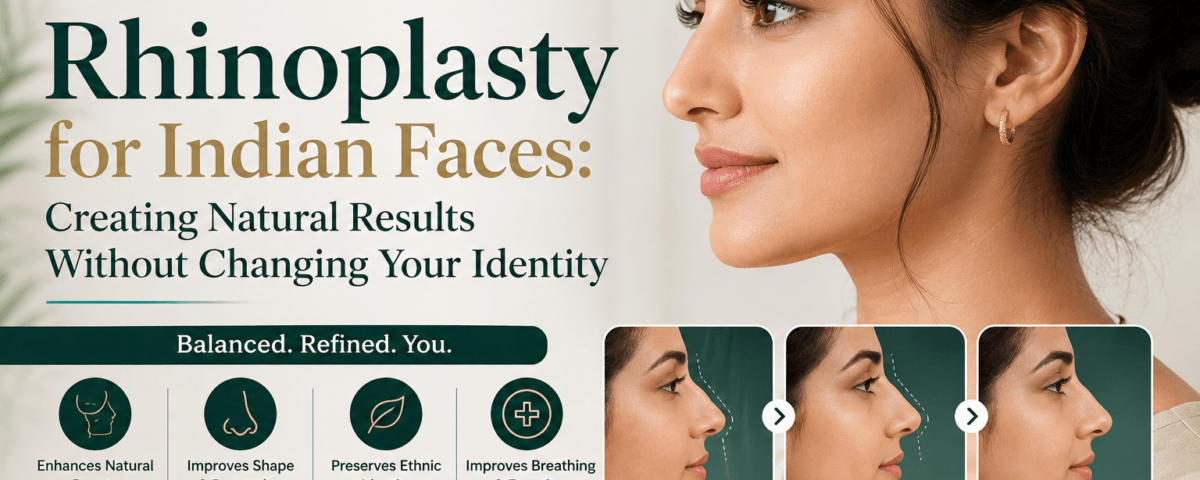
Rhinoplasty for Indian Faces: Creating Natural Results Without Changing Your Identity
Many patients want a more refined nose, but not a face that looks unfamiliar. That is especially important in rhinoplasty for Indian faces, where the goal is often not to “westernize” the nose, but to create better balance while respecting facial identity, skin quality, ethnicity and natural features. This guide explains how natural-looking rhinoplasty is planned, what makes Indian noses different, and what patients in Mumbai should know before choosing surgery.
Who should read this blog?
- Patients who want subtle, natural rhinoplasty results
- People worried about looking “too done” after nose surgery
- Men and women exploring rhinoplasty for Indian facial features
- Anyone comparing refinement versus dramatic change
Why Natural Rhinoplasty Matters So Much for Indian Faces
One of the biggest concerns patients have before rhinoplasty is simple: “Will I still look like myself?” For many Indian patients, that question matters even more than size reduction or profile change. They do not want a copied nose shape. They want a nose that looks softer, more balanced and more proportionate to their face without erasing their natural identity.
Natural rhinoplasty is about harmony, not standardization. It focuses on preserving what suits the face while correcting what feels distracting, such as a drooping tip, broad bridge, hump, asymmetry or lack of definition. When planned well, the nose should blend with the forehead, eyes, lips, chin and skin quality rather than stand out as “surgically altered.”
Natural over artificial
The goal is usually refinement that fits the face, not an over-narrow, over-rotated or obviously altered nose.
Structure matters
Indian noses may need support and shaping, not just reduction, especially when tip definition or bridge balance is part of the concern.
Identity matters
Patients often want their face to look fresher and more balanced while still remaining recognizably their own.
What Makes Rhinoplasty for Indian Faces Different?
No two noses are the same, and there is no single “Indian nose.” Still, some broad patterns may be seen more often in Indian patients, such as thicker skin, a broader bridge, a fuller tip, lower dorsal height in some cases, a drooping tip, or weaker underlying cartilage support. Some patients want a more defined bridge, while others want reduction of width or correction of a hump. Some have breathing concerns in addition to cosmetic ones.
This is why rhinoplasty planning cannot be based on generic beauty standards. The anatomy, skin quality and facial proportions all need individual assessment.
Common Rhinoplasty Goals Among Indian Patients
Patients often come in with one or more of these concerns:
- A broad or less defined nasal bridge
- A bulbous or rounded tip
- Drooping of the nasal tip
- Profile hump or uneven bridge line
- Asymmetry or crooked appearance
- Nose shape that feels too heavy for the face
- Breathing difficulty along with cosmetic concerns
The important thing is that the treatment goal should be clear. A person who wants a softer bridge is different from someone who wants better tip definition, and both are different from a patient who mainly wants functional improvement.
What Does a Natural Rhinoplasty Result Actually Look Like?
A natural result is not one that draws attention to the surgery. It is one where the nose looks more harmonious with the rest of the face. Friends or family may notice that the face looks fresher, more balanced or more photogenic without immediately identifying the reason.
In practical terms, a natural rhinoplasty result usually avoids:
- An over-pinched or overly narrow tip
- A bridge that looks too sharp or too high for the face
- An exaggerated slope that does not fit facial structure
- Excessive rotation that makes the nostrils overly visible
- A copy-paste “Instagram nose” that ignores ethnicity and identity
Want a refined nose without losing your natural look?
A detailed consultation can help you understand what changes may suit your face, what is realistic based on your skin and cartilage support, and how to aim for a balanced result rather than an artificial one.
How Rhinoplasty Is Planned for Facial Harmony
A good rhinoplasty plan starts with the full face, not only the nose. The surgeon usually looks at profile balance, forehead-to-nose transition, bridge line, tip position, nostril shape, chin projection and jawline support. In some faces, even a subtle change in tip position can improve harmony. In others, bridge balance matters more than making the nose smaller.
This is especially important for Indian faces because the aim is usually refinement while retaining character. The nose must not look disconnected from the rest of the face.
Why “Not Changing Your Identity” Is a Real Surgical Goal
Patients often use emotional language during consultation. They may say, “I want to look better, but I don’t want to look different,” or “I want my nose refined, not replaced.” These are not vague wishes. They are actually useful surgical goals.
Identity in facial surgery means preserving recognisable features, family resemblance, ethnic balance and the overall feel of the face. Rhinoplasty should not make someone look like a different person in photographs. Instead, it should reduce the feature that has been bothering them while keeping the face familiar.
What May Be Needed to Achieve Natural-Looking Results
The technique depends on the nose. Some patients need reduction of a hump. Others need tip refinement, support grafting, straightening or breathing correction. In many Indian patients, structural support matters because shaping the nose well is not only about taking tissue away. Sometimes, support has to be improved to create a stable and natural contour.
This is why overly aggressive reduction can be a problem. When too much is removed, the nose may look pinched, unnatural or unsupported. A balanced approach generally works better than simply trying to make the nose smaller.
What If You Also Have Breathing Problems?
Some patients seeking cosmetic rhinoplasty also have functional issues such as blockage, deviation or poor airflow. In such cases, the plan should account for both appearance and breathing. A nose that looks better but functions worse is not a satisfying outcome.
Functional considerations are especially important in revision cases or in patients with existing deviation, asymmetry or trauma history.
| Patient concern | What the plan may focus on | Natural-result principle |
|---|---|---|
| Broad bridge | Refinement and proportion, not over-narrowing | The bridge should suit the rest of the face |
| Bulbous tip | Definition with support-based shaping | The tip should look softer and cleaner, not pinched |
| Drooping tip | Tip support and position correction | Lift should remain balanced and believable |
| Hump or profile imbalance | Bridge contour correction | The profile should look smooth, not overdone |
| Breathing + cosmetic issue | Combined functional and aesthetic planning | Appearance and airflow should both be respected |
Who Is a Good Candidate for Natural Rhinoplasty?
Patients who usually do well are those who want improvement rather than perfection. Good candidates often have a specific concern, such as bridge shape, width, asymmetry or tip refinement, but they also want to remain recognizably themselves. They understand that natural rhinoplasty is about proportion and refinement, not copying another person’s nose.
It also helps when patients are open to a surgeon-led discussion about what will truly suit their face rather than chasing a trend that may not fit their features.
What Happens During the Consultation?
During a rhinoplasty consultation, the surgeon usually examines the nose from the front, side and base view, while also assessing facial profile, chin projection, skin thickness, tip support and breathing pattern. The discussion should also cover what exactly bothers you, what changes you want, and what kind of result would still feel natural to you.
This is often where patients realise that natural-looking rhinoplasty is less about doing “more” and more about doing what is right for their anatomy.
Will a Natural Result Still Be Noticeable?
Yes, but in a balanced way. You may notice a smoother profile, a better-defined tip, less heaviness or improved symmetry. What usually changes is how the nose sits in the face. The face can appear more proportionate without looking dramatically altered.
Recovery and swelling vary from person to person. Final definition may take time, especially in noses with thicker skin. Patience is an important part of the process.
Book a rhinoplasty consultation with Dr. Tushar Thorat
If you are considering rhinoplasty for Indian facial features and want a natural result that preserves identity, a personalized consultation can help you understand what may suit your face and what is realistically achievable.
- Call: +91 98332 81190
- Call: +91 81694 29044
- Book online: Request an Appointment
Frequently Asked Questions
Yes. When the surgery is planned around your facial proportions, skin quality and identity, rhinoplasty can create a more refined result without making the nose look artificial or out of place.
The aim of a natural rhinoplasty approach is to improve balance while preserving facial identity. A well-planned result should still look like you, only more harmonious and refined.
Not always. In many patients, support, shape and proportion matter more than simply making the nose smaller. Over-reduction can sometimes look unnatural.
Thick skin does not rule out rhinoplasty, but it can influence how much fine definition shows and how healing progresses. This is why realistic planning is important.
In some patients, yes. If breathing issues are present, the plan may include functional correction along with aesthetic improvement.
That is best determined during consultation, where the nose is assessed in relation to your profile, bridge, tip, chin and overall facial balance.