

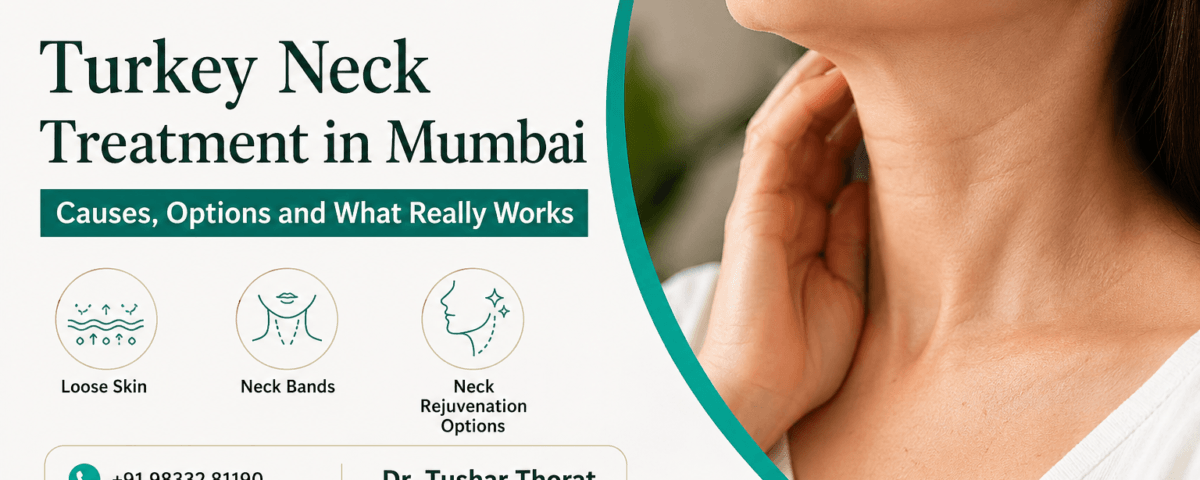
Turkey Neck Treatment in Mumbai: Causes, Options and What Really Works
Loose skin, vertical neck bands, under-chin fullness and a soft, sagging neckline are concerns many people describe as “turkey neck.” It can make the jawline look less defined and the lower face look older than it feels. In this detailed guide, Dr. Tushar Thorat explains what causes turkey neck, which treatments may help, and how to understand what actually works depending on skin quality, muscle laxity and fat under the chin.
Who should read this blog?
- Men and women noticing sagging skin below the chin
- People bothered by neck bands or a less defined jawline
- Patients comparing surgical and non-surgical neck tightening options
- Anyone searching for turkey neck treatment in Mumbai
What Is Turkey Neck?
“Turkey neck” is a common non-medical term used for loose, hanging or crepey skin around the front of the neck, often combined with neck bands, under-chin fullness and poor jawline definition. It usually becomes more noticeable with age, but the appearance can also show up earlier depending on genetics, skin quality, weight changes and lifestyle factors.
Some people mainly notice extra skin. Others see fullness under the chin, a double chin effect, or vertical bands when talking or turning the neck. The important thing is that not every turkey neck looks the same. That is why the right treatment depends on what is actually causing the concern.
Skin laxity
Loose, crepey or hanging neck skin can soften the neckline and make the lower face look heavier.
Platysmal bands
Vertical bands in the neck may become more visible over time and are often part of the aging neck pattern.
Submental fullness
Fat below the chin can reduce jawline sharpness and make the neck look less defined even in younger patients.
What Causes Turkey Neck?
Neck aging is usually gradual. Skin loses elasticity over time, support structures weaken, muscles can become more visible, and fat distribution may change. Some people develop a heavy lower face and neck after weight gain, while others notice laxity after weight loss. The pattern can also be inherited.
Common Signs Patients Notice
- Loose skin hanging below the chin
- A soft or poorly defined jawline
- Vertical neck bands, especially while speaking
- Crepey texture or wrinkled neck skin
- Double chin appearance
- Neck looking older than the face
- Profile photographs showing more neck fullness than expected
Why One Treatment Does Not Work for Everyone
A person with mainly mild skin looseness may need a very different approach from someone with deeper laxity, strong platysmal bands and excess under-chin fat. That is why many people feel disappointed after choosing a treatment based only on advertising rather than a proper neck assessment.
For example, if the main issue is hanging skin and muscle laxity, a purely surface-level treatment may offer only limited improvement. If the issue is mostly under-chin fat in younger skin, a more targeted contouring approach may be enough. The most effective plan comes from matching the treatment to the anatomy.
Thinking about turkey neck treatment in Mumbai?
A detailed consultation can help identify whether your concern is caused mainly by skin laxity, neck bands, submental fat or a combination of these factors. That makes the treatment plan far more meaningful.
Non-Surgical Options for Turkey Neck
Non-surgical options are often considered when the laxity is mild, the patient wants a less invasive route, or the concern is at an earlier stage. These treatments may help selected patients, but it is important to keep expectations realistic.
Skin tightening treatments
Energy-based treatments may be considered for mild looseness and early signs of neck aging. They are usually better suited for patients who still have reasonable skin tone and do not have significant hanging skin.
Injectable options for platysmal bands
In some patients, injectable treatment may help soften visible neck bands. This tends to be more useful when banding is a major concern and skin laxity is not severe.
Fat-focused treatment for under-chin fullness
If the main issue is fullness below the chin rather than loose skin, fat-reduction or contouring approaches may be discussed. However, if excess skin is also present, fat reduction alone may not fully address the appearance.
Surgical Options That May Help
When turkey neck is more advanced, surgery may be the more suitable option for meaningful correction. The exact procedure depends on what is present: loose skin, platysmal banding, fat, jowling, or a combination of facial and neck aging.
Neck lift
A neck lift is often considered when there is visible skin laxity, neck banding and loss of neck contour. It is designed to improve the neckline by addressing deeper support as well as the skin envelope.
Platysmaplasty
If prominent bands and muscle separation are a major part of the concern, platysmal tightening may be part of the surgical plan. This can help improve the central neck contour in selected patients.
Neck liposuction
Neck liposuction may be useful when the concern is mostly under-chin fat and the skin still has enough tone to contract well afterward. It is usually not the ideal standalone treatment for patients with significant skin hanging.
Lower face and neck rejuvenation combination
In some patients, the neck and jawline age together. When jowls and lower-face laxity are also present, a more combined lower face and neck approach may be considered instead of treating the neck alone.
| Main concern | Possible approach | Who it may suit |
|---|---|---|
| Mild early neck laxity | Selected non-surgical skin-tightening options | Patients with mild looseness and realistic expectations |
| Prominent platysmal bands | Band-focused treatment or surgical tightening depending on severity | Patients where vertical banding is a major complaint |
| Submental fat with good skin tone | Neck contouring or liposuction-based approach | Younger patients or those with better skin recoil |
| Loose hanging neck skin | Neck lift-based correction | Patients with moderate to advanced laxity |
| Jawline + neck aging together | Combined lower face and neck rejuvenation plan | Patients with jowling and neck laxity together |
What Really Works for Turkey Neck?
What “really works” depends on the cause and severity. Mild concerns may respond to less invasive options. Moderate to advanced loose skin and deeper tissue laxity usually require more structural correction. This is why patients often hear different advice from different places. The real answer is rarely one-size-fits-all.
In general:
- Mild concerns may improve with carefully selected non-surgical approaches
- Fat under the chin may need contour-focused treatment
- Visible bands may need targeted treatment
- Loose skin and deeper laxity often need surgical correction for more significant change
Who May Be a Good Candidate for Treatment?
You may consider evaluation for turkey neck treatment if your neck looks heavier, looser or more aged than the rest of your face, or if you are bothered by the way your side profile looks in photos or video. Good candidates are usually people with a clear concern, realistic expectations and interest in understanding which approach actually suits their anatomy.
What Happens During a Consultation?
A neck rejuvenation consultation usually involves assessment of skin quality, under-chin fullness, muscle bands, jawline definition and overall face-neck balance. This helps determine whether the concern is mainly skin-based, fat-based, muscle-based or mixed.
This is also the right time to discuss whether the goal is subtle improvement, better profile balance or more noticeable neck contouring. A thoughtful consultation matters because neck treatment planning is highly individualized.
Book a consultation with Dr. Tushar Thorat
If you are exploring turkey neck treatment in Mumbai, a personalized assessment can help clarify what is causing the concern and which options may be worth considering for your needs.
- Call: +91 98332 81190
- Call: +91 81694 29044
- Book online: Request an Appointment
What About Recovery?
Recovery depends on the treatment chosen. Non-surgical options usually involve less downtime, though results may be more modest and may require more than one session in selected cases. Surgical neck correction generally involves a longer recovery period, but it may be more relevant for patients with significant skin laxity or muscle-related changes.
Recovery, aftercare and the pace of visible improvement vary from one patient to another. This should always be discussed in detail based on the actual treatment plan.
Can Turkey Neck Be Prevented?
Not completely, but some factors can be slowed or managed. Maintaining a stable weight, protecting skin from sun damage, following a healthy lifestyle and addressing concerns earlier rather than later may help. Still, genetics and natural aging play a major role, so prevention is not always fully possible.
Frequently Asked Questions
Turkey neck is usually caused by a combination of loose skin, muscle banding, tissue laxity and sometimes fat below the chin. In many patients, more than one factor is involved.
Exercise may support general fitness and weight control, but it does not typically correct significant loose neck skin or deeper structural laxity.
They may help selected patients with mild concerns, especially early skin laxity or limited banding. For more advanced neck aging, improvement may be limited and surgical options may be more suitable.
Surgery is often considered when there is moderate to significant loose skin, strong platysmal bands, or a need for more structural correction than non-surgical options are likely to provide.
Aging is a major factor, but genetics, weight changes, skin quality and natural anatomy can also make the concern appear earlier.
The best way is through an in-person consultation where the neck, jawline, skin and deeper structures are assessed properly before deciding on any plan.